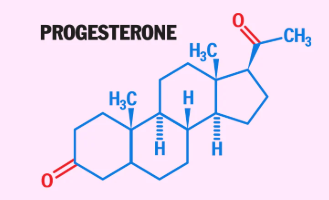
Progesterone gets treated as an afterthought, something you add for safety reasons if you happen to still have a uterus. I disagree with that framing entirely, and so does the data. Progesterone is not a progestin. Lumping them together has cost women access to a hormone that does real, active work throughout the body, not just a hormone you tolerate to protect your endometrium.
Is Progesterone the Same Thing as a Progestin?
No. Micronized progesterone is structurally identical to the hormone your own ovaries produce. Synthetic progestins, including medroxyprogesterone acetate and norethisterone acetate, have an entirely different chemical structure. They activate the progesterone receptor, which is why they get grouped under the same name, but many of them also bind androgen, glucocorticoid, and other hormone receptors that progesterone itself does not meaningfully touch (Asi et al., 2016, Systematic Reviews). That extra receptor activity is the reason synthetic progestins and real progesterone behave so differently once they're in your body.
What Does Progesterone Actually Do in Your Brain?
More than most people realize, and this is where progesterone earns its place on its own merits, separate from any conversation about risk. Progesterone converts in the brain into allopregnanolone, a compound that calms brain activity through the same receptors targeted by anti-anxiety medications. It also supports the cells that build and repair myelin, the protective coating around your nerve fibers, and it reduces inflammatory activity in the brain's own immune cells (Noorbakhsh et al., 2014, Frontiers in Cellular Neuroscience). Synthetic progestins don't do this. They were never going to, since they aren't converted into allopregnanolone the way progesterone is.
Does Better Sleep Actually Lower Inflammation?
Yes, and this is a direct extension of progesterone's calming effect on the brain. Many women sleep more soundly in the days after ovulation, when progesterone is highest, and sleep often gets worse as progesterone declines in perimenopause. That matters beyond comfort. A study measuring sleep quality directly in menopausal women found that poor sleep was linked to measurably higher levels of inflammatory markers in the blood, holding up even after accounting for age, weight, and hormone levels themselves (Bertone-Johnson et al., 2017, Menopause). Restoring progesterone supports sleep, and supporting sleep lowers inflammation in its own right.
Does This Show Up in Other Parts of the Body Too?
Yes, consistently, and not just in breast tissue. The same pattern, progesterone behaving more favorably than synthetic progestins, shows up clearly in blood clot research, an entirely separate body of work from cardiology, with no connection to the breast cancer cohorts. A major French study following postmenopausal women found synthetic progestins, particularly a class called norpregnane derivatives, significantly increased blood clot risk, while micronized progesterone did not (Canonico et al., 2007, Circulation). The American College of Obstetricians and Gynecologists states it plainly too: natural progesterone has not been associated with increased blood clot risk, while synthetic progestins like medroxyprogesterone acetate have (ACOG Committee Opinion). When the same distinction holds up across the brain, the blood, and breast tissue, studied by completely different research teams for completely different reasons, that's not a coincidence.
What About Breast Cancer Risk Specifically?
This is where the evidence runs deepest. The French E3N cohort, run through INSERM, has confirmed this finding three separate times as follow-up extended over a decade. The 2008 analysis of 80,377 postmenopausal women found the elevated breast cancer risk tied to combined hormone therapy was concentrated in synthetic progestogens, not progesterone (Fournier et al., 2008, Breast Cancer Research and Treatment). The 2014 follow-up, with 78,353 women, found that among short-term users, only those on a progestogen other than progesterone or dydrogesterone showed a significantly elevated risk (Fournier et al., 2014, Breast Cancer Research and Treatment). A 2016 meta-analysis pooling this data with other cohorts found progesterone associated with significantly lower breast cancer risk than synthetic progestins when each was combined with estrogen (Asi et al., 2016, Systematic Reviews). There's a biological reason behind these numbers too: a randomized trial comparing breast tissue biopsies found measurably less proliferative gene activity in women given estradiol with micronized progesterone than in women given conjugated equine estrogen with medroxyprogesterone acetate (Courtin et al., 2023, Breast Cancer Research).
Did HABITS and Stockholm Use Bioidentical Progesterone?
No, and this gets overlooked constantly, including in earlier framing of my own. The HABITS trial, the one randomized trial in breast cancer survivors that found a significant increase in recurrence, used norethisterone acetate, a synthetic, androgenic progestin (Holmberg & Anderson, 2004, Lancet). The Stockholm trial, which found a smaller, non-significant increase, used medroxyprogesterone acetate, also synthetic, just a different molecule (Fahlén et al., 2013, European Journal of Cancer). Neither trial tested bioidentical progesterone. The studies most often cited as proof that "hormones cause recurrence" never actually tested the hormone this article is about.
What About Breast Cancer Survivors?
The breast cancer data above comes from women with no personal history of the disease, so the right way to use it if you're a survivor is as the starting point for a specific conversation with your oncologist, not as a settled answer on its own.
What I Actually Recommend
I use micronized progesterone broadly, not as an add-on reserved for women with a uterus. Treating it as purely an endometrial safety requirement sells it short. It does real, active work for sleep and nervous system health on its own merits, and it carries a consistently better safety profile than synthetic progestins across blood clot research and breast cancer research alike, two separate bodies of evidence, built by different teams, landing in the same place. That combination, genuine benefit plus a better safety record, is why progesterone is a default in my practice rather than a fallback.
Frequently Asked Questions
Is "bioidentical progesterone" just a marketing term? No. It's a structural fact, molecularly identical to what your ovaries produce, distinct from synthetic progestins that behave differently in your brain, your blood vessels, and your breast tissue.
Does progesterone only matter for hormone balance? No. It plays a direct role in sleep, brain health, and inflammation regulation that goes well beyond its reproductive function, and synthetic progestins don't replicate most of that.
Why did the Stockholm trial show a smaller breast cancer risk increase than HABITS? The specific progestin used, not bioidentical progesterone. Both trials used synthetic molecules with different activity profiles.
If progesterone is this beneficial, why do guidelines still limit it to women with a uterus? Because most guidelines were built around a narrower question, endometrial protection, rather than progesterone's broader role in the body. I don't think that narrower question should be the only one guiding the decision.
If you've been told to avoid "hormones" without anyone distinguishing which hormone, or which version of it, that conversation deserves more precision than you have probably been given. Book a complimentary discovery call at doctoranat.com. No pressure, no commitment. Just a real conversation about what is actually happening in your body and what your options are.
Book your complimentary discovery call at doctoranat.com
Dr. Anat Sapan MD is a board-certified OB-GYN and menopause specialist, exclusively focused on personalized bioidentical hormone therapy for women in their 40s, 50s, 60s, and beyond. She serves patients via telemedicine in California, Florida, New York, and Illinois.

Anat Sapan MD
Contact Me